
 PL
PL EN
EN DE
DE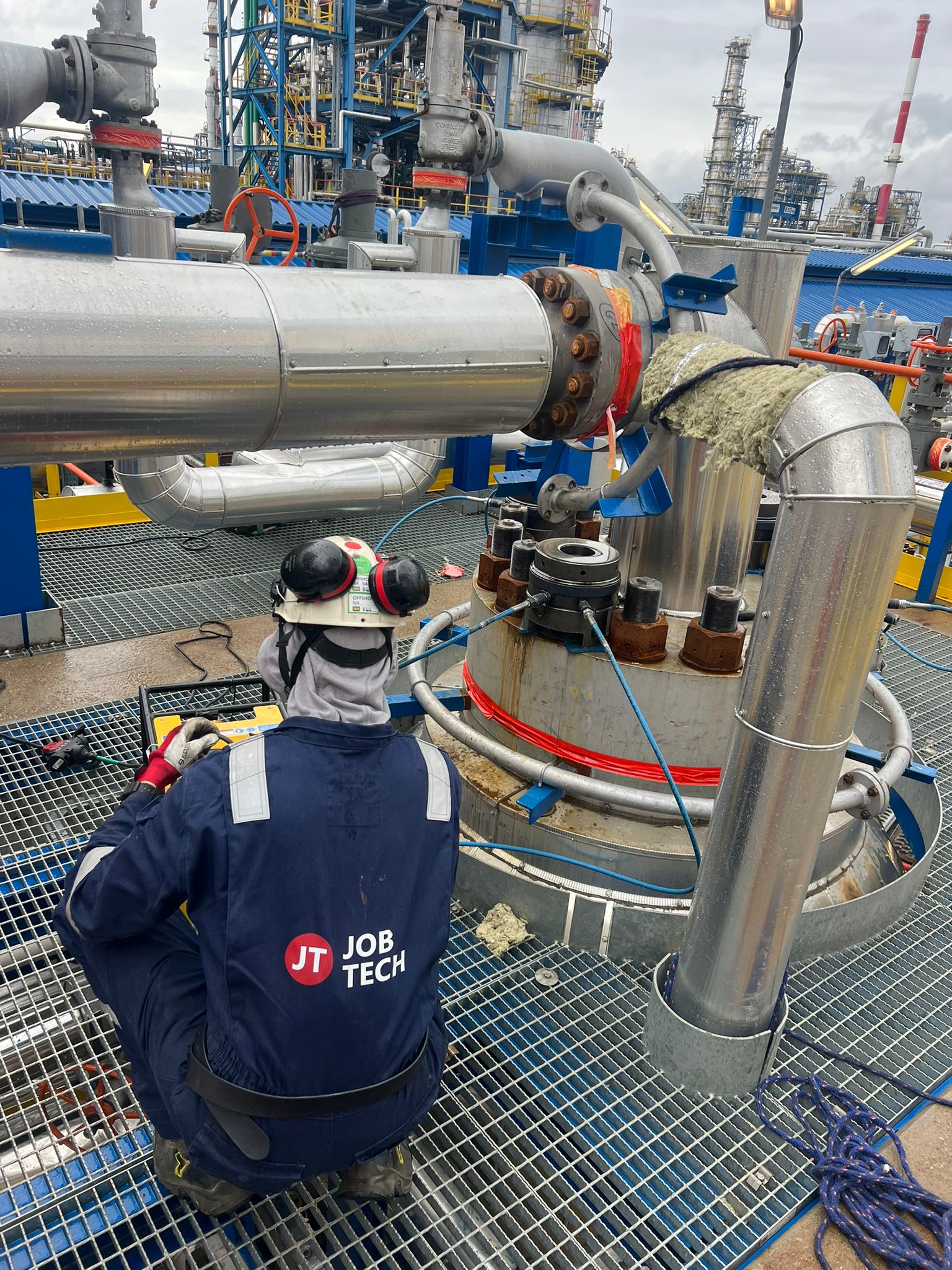
Hydraulic Bolt Tensioning in Commissioning: Controlled Clamping of Flanged Joints
A technical guide to hydraulic bolt tensioning within mechanical works, functional testing and the commissioning of industrial installations. How JobTech delivers controlled clamping of flanged joints in international projects.

The tightness of a flanged joint does not depend on how hard a technician turns the nut, but on the axial force actually generated in the bolt shank. In industrial installations — process piping, heat exchangers, reactors, pump and compressor heads — it is this controlled clamping force that decides whether a joint passes its pressure test first time and holds tight in service. Hydraulic bolt tensioning is the method that lets you achieve that force in a precise, repeatable and documented way.
For JobTech, bolt tensioning is not a service detached from the rest of the project. It is part of the mechanical works, functional testing and commissioning support that we also deliver as part of our export activity — for foreign equipment manufacturers and international EPC teams working on sites in Poland and abroad.
Why torque alone is not enough
Conventional tightening with a torque wrench relies on turning moment. The problem is that only a small part of the applied torque is converted into axial force — the rest is lost to friction under the nut and on the thread. The friction coefficient depends on surface condition, lubricant, thread quality and temperature, so at the same torque the real clamping force can vary by tens of percent. On large-diameter bolts, in high pressure classes, this uncertainty is unacceptable.
Hydraulic tensioning avoids the problem. A tensioner is fitted onto the bolt, and a hydraulic cylinder stretches the shank axially using a set oil pressure. Only once the elongation is reached is the nut wound down effortlessly, “to the seat”. When the pressure is released, the force is locked into the bolt. The result is predictable: because we know the pressure-to-force relationship, we know the stress in every single shank.
Simultaneous tensioning and load distribution
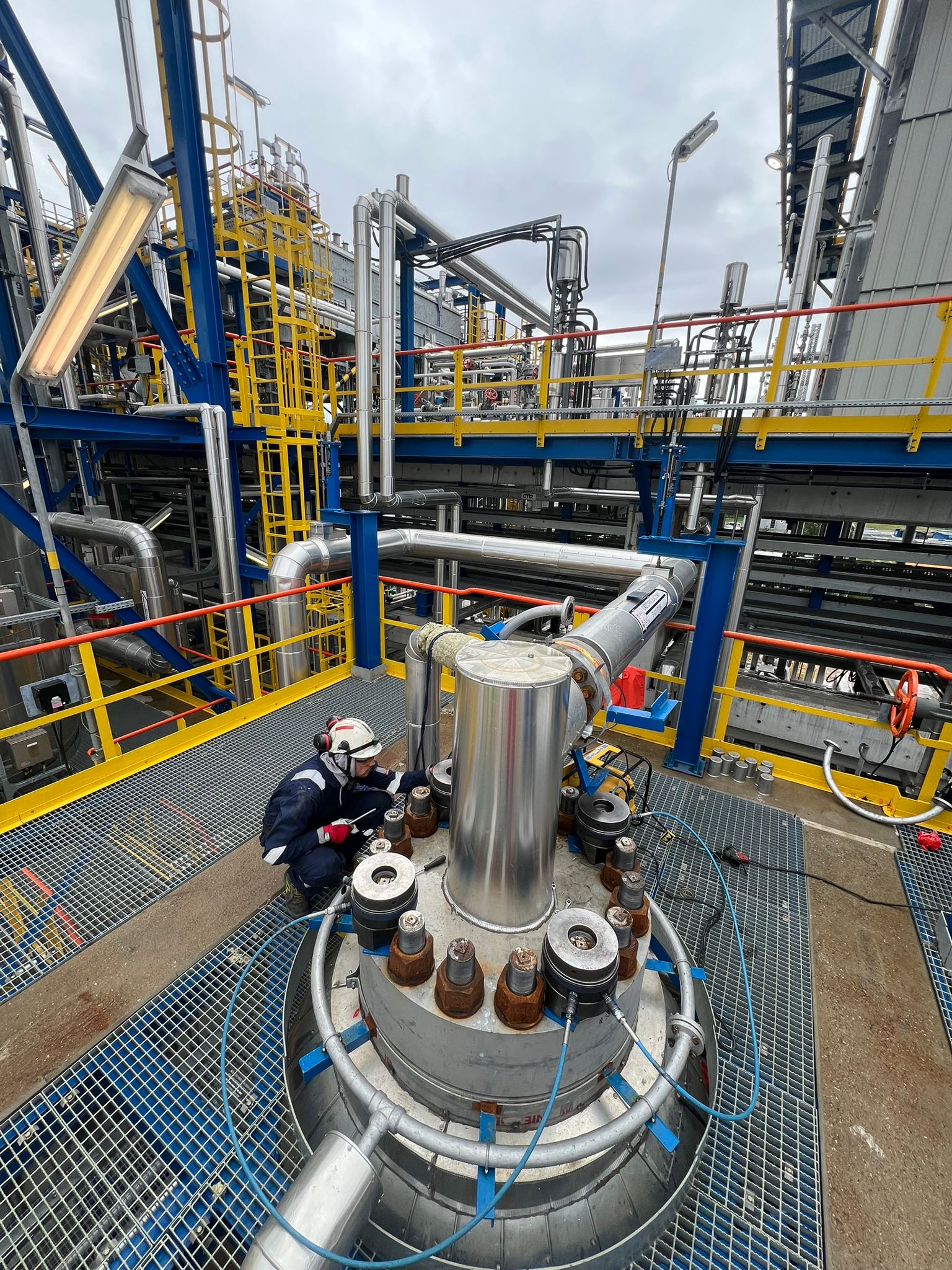
The advantage of the hydraulic method comes to the fore on multi-bolt joints. Several tensioners connected to a single hydraulic system can be loaded simultaneously at the same pressure, giving an even clamp around the whole flange circumference. The gasket is compressed symmetrically, without the tilt that appears with cross-pattern tightening when each successive bolt relaxes the ones already done.
In practice, a tensioner coverage ratio is chosen (e.g. every second bolt) and a sequence of several passes at rising pressure plus a check pass is performed. This procedure limits cross-talk — the mutual interaction of neighbouring bolts — and produces a stress distribution that stays within a narrow tolerance.
| Parameter | Meaning in practice |
|---|---|
| Tensioning pressure | Converted into the target axial bolt force |
| Coverage ratio | Number of tensioners working simultaneously |
| Number of passes | Successive load cycles plus a check pass |
| Loss factor | Allowance for relaxation after tensioner removal |
| Documentation | Record of pressures and joint identification |
Where tensioning sits in the commissioning sequence
Bolt tensioning is not an activity in itself — it is a link in the chain that leads from mechanical completion to safe operation. Order matters. A flanged joint is first assembled mechanically: parallelism and alignment of the flanges, the condition of the sealing faces, the class and condition of the gasket and the bolt certificates are all checked. Only an aligned joint with a correctly seated gasket is ready to be tensioned.
Tensioning is followed by pressure and leak testing. A correctly executed clamp is the condition for the joint to pass the test without leaks and without the need for retesting. Repeating a pressure test means extra man-hours, schedule pressure and unnecessary risk on site — which is why controlled clamping translates directly into the cost and time of commissioning.
For joints operating at high temperature, hot bolting is also planned — a correction of the clamp after the first heat-up of the installation, once the gasket and bolts have settled. This is already an element of functional testing and early operation, in which the mechanical team works alongside the operating crew.
Safety and working conditions on site
Hydraulic tensioning is work with high oil pressure — systems operate at pressures of hundreds of bar. This calls for sound hoses, couplings and gauges, a leak check of the system before loading, and a defined work zone. The rule is that while the pressure is being raised, no one interferes with the tensioner. On process sites there are also the surrounding conditions: work on gratings and pipe racks, restricted access to flanges, the proximity of live installations and the permit-to-work regime.
Field experience decides whether the method works as it does in theory. Matching the tensioner to the bolt diameter and class, the correct pullers and bridges, allowing for joint relaxation, the right sequence and clean threads — these are the details that separate a joint that is tight first time from one that has to be re-tensioned.
Bolt tensioning in JobTech’s export projects
In international projects, teams work to EN and ASME standards and to the client’s QA/QC requirements, often across several languages and procedures at once. Traceability is key: every critical joint should have an assigned target force, tensioning pressure, sequence and a record confirming completion. Such documentation is part of the handover package for commissioning and evidence of the proper execution of mechanical works.
For a foreign equipment manufacturer supplying the Polish market or delivering a contract in the region, the presence of a local execution team removes a real barrier to entry. The manufacturer has the technology; JobTech provides the hands, equipment and procedures that bring the installation to safe operation — from mechanical assembly and joint tensioning, through pressure and leak testing, to functional tests and commissioning support.
Do you need precise clamping of flanged joints?
JobTech performs hydraulic bolt tensioning and torqueing as part of the mechanical works, testing and commissioning of industrial installations — on process piping, heat exchangers, reactors, machine heads and critical joints. We carry out the work with full documentation, in line with standards and client requirements, including in international and export projects. If you are planning the assembly, functional testing or commissioning of an installation where repeatable, documented clamping matters — let’s talk.

Have questions about industrial installations?
Contact our team — we will be happy to discuss your project requirements and propose the optimal solution.
Get in toucharrow_forward