
 PL
PL EN
EN DE
DE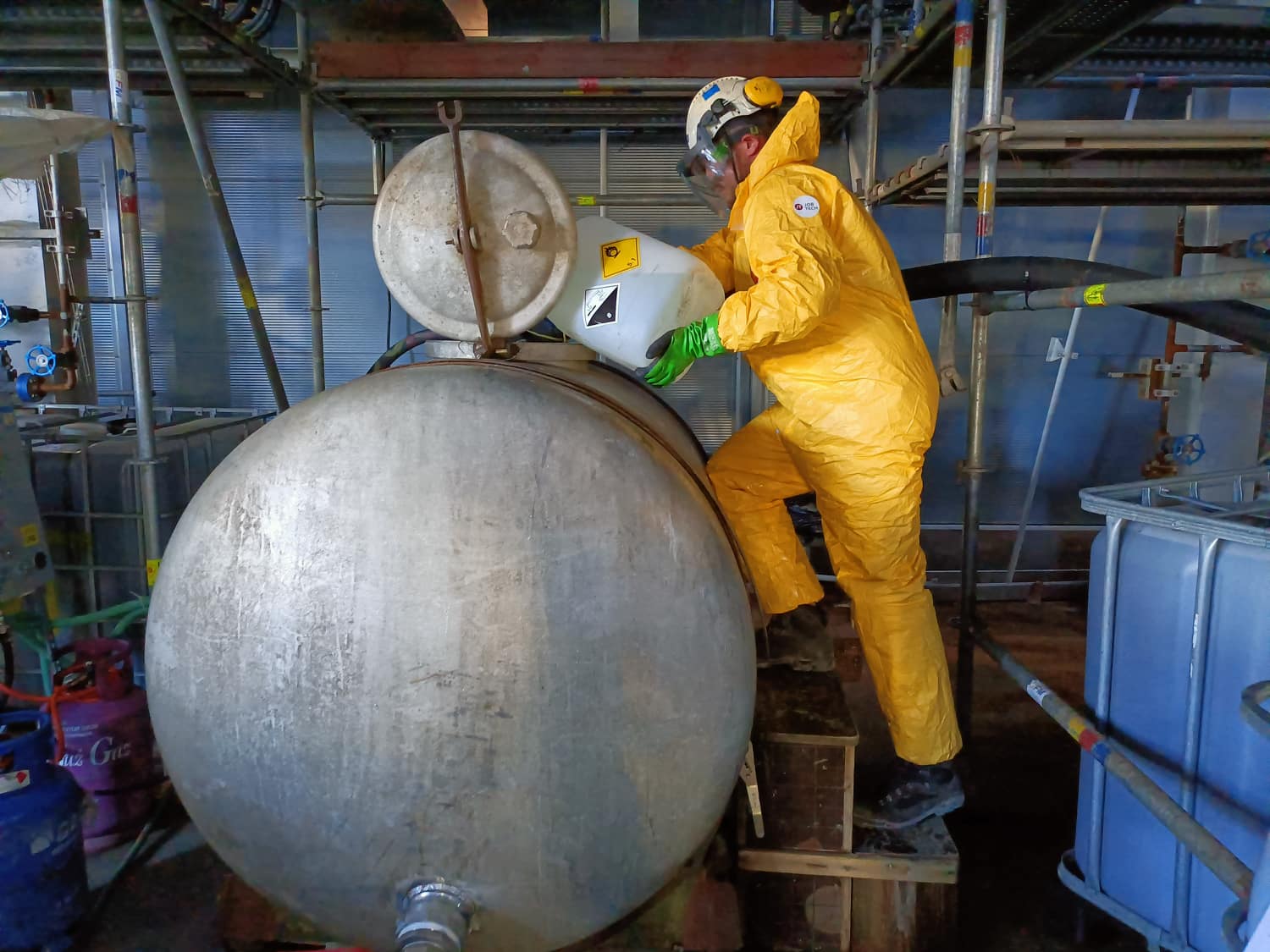
Pipeline Cleaning Before Commissioning: When Is It Worth Doing?
Mill scale, weld spatter, grinding dust and shop preservative do not leave the pipe on their own. A technical guide to flushing, blowing and chemical cleaning before commissioning: how the methods differ, what the acceptance criteria are, and which systems cannot be started without a proper clean.

A pipeline that has been welded, pressure tested and handed over by the erection team is mechanically complete. It is not clean. Inside there is still mill scale from hot rolling, rust picked up in storage, weld spatter, shop preservative and the water left over from the hydrotest. The first flow of process medium turns that into an abrasive slurry and carries it into the parts of the plant that tolerate it least.
So cleaning has a place of its own in the schedule, between mechanical completion and commissioning. What is usually still open is how far to take it. A water flush covers a lot of ground and costs little. Chemical cleaning with degreasing, pickling and passivation takes days and needs permits and trained crews, and it is sometimes the only thing that works.
At JobTech this sits inside the same scope as mechanical works, pressure testing and commissioning support, which we deliver on export projects for foreign equipment manufacturers and international EPC teams.
What construction leaves inside the pipe
None of it is a sign of bad workmanship. Hot-rolled pipe leaves the mill with a bonded oxide layer that stays put until the first thermal cycles start flaking it off. Months on a laydown yard add corrosion products, welding adds slag and spatter, and the fabrication shop adds cutting oil. Site work contributes sand, the occasional electrode stub and, now and then, a gasket offcut nobody noticed.
Hydrotest water is a problem in its own right. Left standing, it corrodes carbon steel. On austenitic stainless it does worse: once chloride content climbs past roughly 50 ppm the water starts pitting the surface and can initiate stress corrosion cracking before the plant has run for an hour. That is why specifications cap chlorides in test water and rule out sea water for stainless service.
What it costs to skip
The money for contamination does not come out of the cleaning budget. It comes out of the commissioning schedule.
Debris blinds a temporary strainer, the pump loses suction and cavitates. Hard particles score seal faces and bearing journals. On turbomachinery, contamination is the single largest cause of dry gas seal failure, and most of it gets in during commissioning rather than in operation. Control valves that stood full of flush water and rust do not stroke cleanly, and no tuning fixes the loop afterwards. Orifice plates read wrong, so functional test data describes a plant that does not exist. In steam service, particles carried into a turbine erode blading within minutes.
Every one of those cases means stripping something down, waiting on parts with long lead times, and repeating tests that were already signed off.
Choosing a method
The medium decides most of it. Line geometry and the equipment sitting downstream decide the rest.
Water flushing is where liquid lines start, and velocity does the work. It normally runs at one and a half to twice the operating velocity, and the flow has to beat the settling velocity of whatever is being removed: roughly 3 m/s for particles above 500 µm, roughly 1.5 m/s in the 100 to 500 µm range. Run it slower and the debris relocates to the next low point. Gas lines and instrument air are blown through with air or nitrogen instead, at 25 to 35 m/s.
Steam lines feeding a turbine are the one case where cleanliness becomes a number rather than an opinion. The blow is sized so its dynamic pressure exceeds the operating value, giving a cleaning force ratio of at least 1.0 and in practice 1.2 or better, and the result is read off a polished target plate. The line is not accepted until consecutive blows produce plates inside the turbine maker’s impact criteria.
Lubrication, seal and control oil systems get high-velocity oil flushing. The flow has to be turbulent, so a Reynolds number above 4 000, though most procedures aim for 8 000 to 10 000, with the oil heated to around 65 to 75 °C to bring the viscosity down. Acceptance here is a laboratory result, an ISO 4406 class, not a look down the bore.
Chemical cleaning starts where all of that runs out, on contamination chemically bonded to the metal that no velocity will shift.
| System | Method | Acceptance criterion | Reference |
|---|---|---|---|
| Process liquid piping | Water flushing | Clean temporary strainer | ASME B31.3 |
| Gas lines, instrument air | Air or nitrogen blowing | Particle-free discharge | Industry practice |
| Steam lines to turbine | Steam blowing | Target plate, cleaning force ratio 1.0 or more | ASME B31.1 / OEM |
| Lube, seal and control oil | High-velocity oil flushing | ISO 4406 class, e.g. 16/14/11 | API 614 |
| Boilers, exchangers, oil lines | Chemical cleaning | Passivated surface, rinse pH 6 to 8 | ASTM A380 |
The chemical cleaning sequence
First the system comes off line and a temporary circuit goes on: pumps, tanks, heating, hoses, and jumper spools in place of every control valve, meter and orifice plate. Nothing circulates through instrumentation or bearings.
Alkaline degreasing comes first: oil and preservative on the surface keep the acid away from the scale underneath. Pickling then dissolves the oxide, and the choice of acid depends on what is actually in the pipe. Ammoniated citric acid suits the light ferrous deposits typical of a new installation. Hydrochloric acid at around 5 per cent deals with heavier mill scale on carbon steel. EDTA suits a heavy oxide load, where a long, slow contact time is safer than a fast aggressive one. The solution carries a corrosion inhibitor, and temperature and contact time are watched closely, since an over-pickled surface is etched parent metal.
Rinsing and neutralisation bring the final rinse to a pH of 6 to 8, tightened to 6 or 7 on critical systems. Passivation restores the protective film so that freshly bared metal does not flash rust within hours. The system is then dried and either blanketed with nitrogen or filled with a preservation fluid, depending how long it waits for startup. Spent solutions are hazardous waste, neutralised and collected for disposal.
So when is it worth it?
The honest answer is that it depends on what sits downstream and on what a week of lost commissioning costs.
Chemical cleaning earns its place on systems feeding turbomachinery, on lube and seal oil circuits, on boilers, HRSGs and steam lines to a turbine, and on oxygen service, where degreasing is a safety requirement rather than a quality one. Catalytic reactors belong on the list too, because carried-over iron poisons a bed.
For short utility lines, cooling water and non-critical service with no rotating equipment downstream, a flush or a blow is proportionate, and a coarse start-up filter carries whatever is left.
Two situations override that judgement. Piping that sat outdoors for a long time before erection, and systems left standing full of hydrotest water, both carry corrosion products that formed after the pipe left the mill. Flushing will not touch them.
Cleaning on JobTech’s export projects
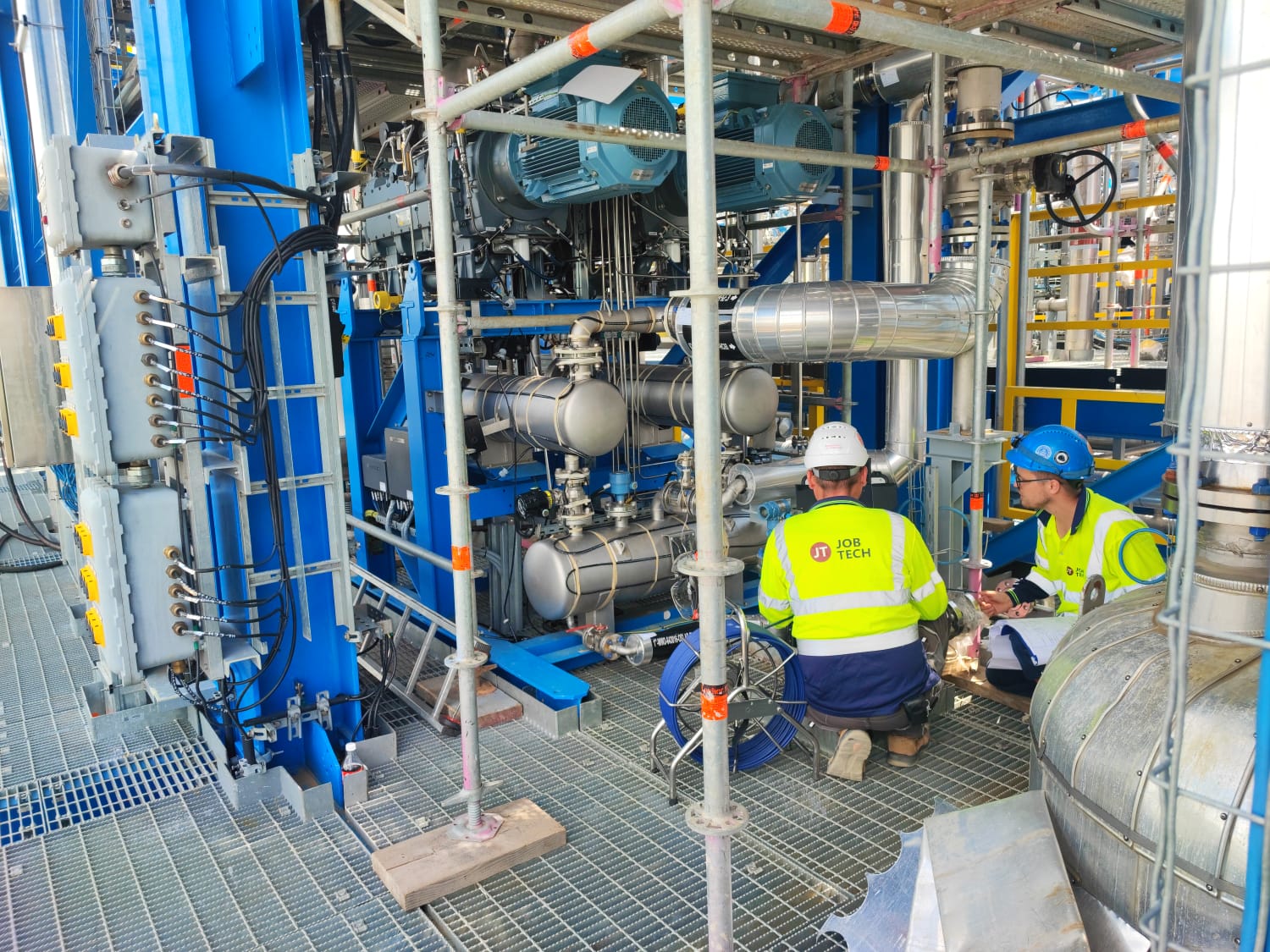
On an international contract the cleaning stage produces paperwork as well as a clean surface. Every circuit needs a stated method, the parameters it was actually run at (velocity, temperature, concentration, contact time), an acceptance criterion and a signed record that the criterion was met. The work follows EN and ASME standards and the client’s QA/QC requirements, and the records go into the handover package.
For an equipment manufacturer supplying the Polish market, having an execution team on the ground removes a real barrier to entry. The technology and the acceptance criteria come from the manufacturer. The crews, pumps, tanks, chemicals and procedures come from us.
Planning the cleaning and commissioning of an installation?
JobTech carries out flushing, chemical cleaning and pressure and leak testing of industrial piping and equipment, as part of mechanical works and commissioning support, fully documented and to the client’s standards. If you are working out how far the cleaning on your system needs to go, get in touch.

Have questions about industrial installations?
Contact our team — we will be happy to discuss your project requirements and propose the optimal solution.
Get in toucharrow_forward